Teaspoon to Grams Conversion Chart
Every common gram and teaspoon amount, across every ingredient, in one sortable table. Look up the number or use the calculator for anything in between.
Granulated sugar · 10 grams equals
2.38teaspoons
The default when a recipe just says "sugar". Free-flowing, so it needs no packing.
Formula: grams ÷ 4.2 = teaspoons
Calculated in your browser — nothing is uploaded or stored.
Level teaspoons
1 tsp granulated sugar = 4.2 g
One level teaspoon of granulated sugar (white) weighs approximately 4.2 grams, based on a bulk density of 0.8525 grams per millilitre and a US teaspoon of 4.93 millilitres.
- Based on standard culinary reference values
- No login required — 100% free
- Your data never leaves your browser
Last updated · Reviewed by the Ali Raza
What does a teaspoon weigh in grams?
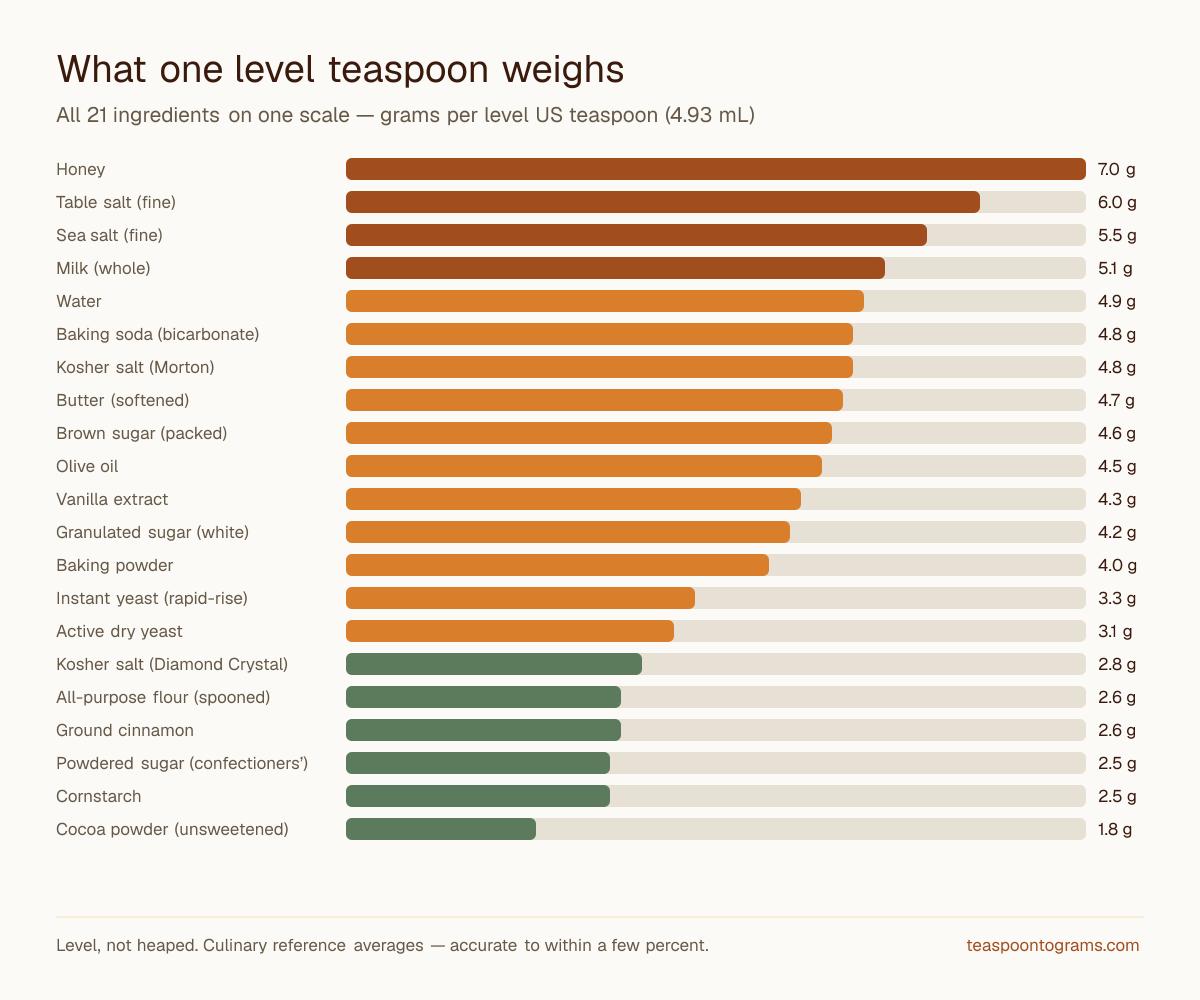
A level teaspoon holds 4.93 millilitres, and what that weighs depends on the ingredient. It comes to 4.2 g of granulated sugar, 6.0 g of table salt, 3.1 g of active dry yeast and 2.6 g of all-purpose flour. The chart below gives every common amount for each.
Each figure is that volume multiplied by the ingredient's bulk density, which is why the range across the table runs from 1.8 g for cocoa powder to 7.0 g for honey. Heavier ingredients are the dense, fine-grained ones that pack with little air; the light end is where a spoonful is mostly air by volume.
Read the chart in either direction. To go from grams to teaspoons, divide by the per-teaspoon weight; to go the other way, multiply. All values assume level spoons and are culinary reference averages, accurate to within a few percent rather than to the milligram.
How it's calculated
The numbers behind the chart
Every cell in the chart is calculated the same way: the ingredient’s bulk density in grams per millilitre, multiplied by 4.92892159375 millilitres to get its weight per teaspoon, then divided into (or multiplied by) the amount you are converting.
Because the whole table derives from one density figure per ingredient, the grams-to-teaspoons and teaspoons-to-grams views can never disagree with each other, and neither can disagree with the calculator above.
| One level teaspoon of… | Weighs |
|---|---|
| Granulated sugar | 4.2 g |
| Table salt | 6.0 g |
| Active dry yeast | 3.1 g |
| Baking soda | 4.8 g |
| All-purpose flour | 2.6 g |
| Water | 4.9 g |
The chart
Grams and teaspoons, side by side
Switch direction with the toggle. Every amount from the keyword research is covered, so you shouldn't need a second page.
| Grams | Granulated sugar4.2 g/tsp | Table salt6.0 g/tsp | Active dry yeast3.1 g/tsp | Instant yeast3.3 g/tsp | Baking soda4.8 g/tsp | All-purpose flour2.6 g/tsp | Water4.9 g/tsp |
|---|---|---|---|---|---|---|---|
| 1 g | 0.238 tsp≈ ¼ tsp | 0.1666 tsp | 0.3226 tsp | 0.303 tsp | 0.2083 tsp | 0.3845 tsp | 0.2029 tsp |
| 2 g | 0.476 tsp≈ ½ tsp | 0.3333 tsp | 0.6451 tsp | 0.606 tsp | 0.4166 tsp | 0.7691 tsp≈ ¾ tsp | 0.4058 tsp |
| 3 g | 0.714 tsp | 0.4999 tsp≈ ½ tsp | 0.9677 tsp | 0.909 tsp | 0.6249 tsp | 1.154 tsp | 0.6087 tsp |
| 4 g | 0.9519 tsp | 0.6666 tsp | 1.29 tsp | 1.212 tsp | 0.8332 tsp | 1.538 tsp | 0.8115 tsp |
| 5 g | 1.19 tsp | 0.8332 tsp | 1.613 tsp | 1.515 tsp≈ 1½ tsp | 1.041 tsp | 1.923 tsp | 1.014 tsp≈ 1 tsp |
| 7 g | 1.666 tsp | 1.166 tsp | 2.258 tsp≈ 2¼ tsp | 2.121 tsp | 1.458 tsp | 2.692 tsp | 1.42 tsp |
| 10 g | 2.38 tsp | 1.666 tsp | 3.226 tsp≈ 3¼ tsp | 3.03 tsp≈ 3 tsp | 2.083 tsp | 3.845 tsp | 2.029 tsp≈ 2 tsp |
| 11 g | 2.618 tsp | 1.833 tsp | 3.548 tsp | 3.333 tsp | 2.291 tsp | 4.23 tsp≈ 4¼ tsp | 2.232 tsp≈ 2¼ tsp |
| 15 g | 3.57 tsp | 2.5 tsp≈ 2½ tsp | 4.838 tsp | 4.545 tsp | 3.124 tsp | 5.768 tsp≈ 5¾ tsp | 3.043 tsp |
| 20 g | 4.76 tsp≈ 4¾ tsp | 3.333 tsp | 6.451 tsp | 6.06 tsp | 4.166 tsp | 7.691 tsp | 4.058 tsp |
| 25 g | 5.95 tsp | 4.166 tsp | 8.064 tsp | 7.575 tsp | 5.207 tsp | 9.614 tsp | 5.072 tsp |
| 30 g | 7.14 tsp | 4.999 tsp≈ 5 tsp | 9.677 tsp | 9.09 tsp | 6.249 tsp≈ 6¼ tsp | 11.54 tsp | 6.087 tsp |
| 40 g | 9.519 tsp≈ 9½ tsp | 6.666 tsp | 12.9 tsp | 12.12 tsp | 8.332 tsp | 15.38 tsp | 8.115 tsp |
| 50 g | 11.9 tsp | 8.332 tsp | 16.13 tsp | 15.15 tsp | 10.41 tsp | 19.23 tsp | 10.14 tsp |
| 100 g | 23.8 tsp | 16.66 tsp | 32.26 tsp | 30.3 tsp | 20.83 tsp | 38.45 tsp | 20.29 tsp |
All figures assume level teaspoons of the ingredient as normally stocked — spooned and levelled flour, firmly packed brown sugar, unsifted powders. Values are culinary reference averages and vary by a few percent with brand and humidity.
Full reference
All 21 ingredients, per level teaspoon
The complete density table this site is built on.
| Ingredient | 1 tsp | 1 tbsp |
|---|---|---|
| Granulated sugar (white) | 4.2 g | 12.61 g |
| Table salt (fine) | 6.0 g | 18 g |
| Active dry yeast | 3.1 g | 9.3 g |
| Instant yeast (rapid-rise) | 3.3 g | 9.9 g |
| Baking soda (bicarbonate) | 4.8 g | 14.4 g |
| Baking powder | 4.0 g | 12 g |
| Brown sugar (packed) | 4.6 g | 13.74 g |
| Powdered sugar (confectioners’) | 2.5 g | 7.5 g |
| Kosher salt (Diamond Crystal) | 2.8 g | 8.4 g |
| Kosher salt (Morton) | 4.8 g | 14.4 g |
| Sea salt (fine) | 5.5 g | 16.5 g |
| All-purpose flour (spooned) | 2.6 g | 7.8 g |
| Cornstarch | 2.5 g | 7.5 g |
| Cocoa powder (unsweetened) | 1.8 g | 5.31 g |
| Ground cinnamon | 2.6 g | 7.8 g |
| Water | 4.9 g | 14.79 g |
| Milk (whole) | 5.1 g | 15.26 g |
| Honey | 7.0 g | 21 g |
| Olive oil | 4.5 g | 13.57 g |
| Butter (softened) | 4.7 g | 14.18 g |
| Vanilla extract | 4.3 g | 13 g |
Quick answers
Straight answers to the exact amounts people ask about
- How many teaspoons is 4 grams?
- 0.9519 tsp of granulated sugar, 0.6666 tsp of table salt, or 1.29 tsp of active dry yeast.
- How many teaspoons is 7 grams?
- 1.666 tsp of granulated sugar, or 2.258 tsp of active dry yeast — the standard yeast sachet size.
- How many teaspoons is 11 grams?
- 2.618 tsp of granulated sugar, 1.833 tsp of table salt, or 3.548 tsp of active dry yeast.
- How many teaspoons is 20 grams?
- 4.76 tsp of granulated sugar, 3.333 tsp of table salt, or 7.691 tsp of flour.
- How many teaspoons is 40 grams?
- 9.519 tsp of granulated sugar — over 3 tablespoons. At this weight a scale is more practical than counting spoons.
- How many grams is 10 teaspoons?
- 42.02 g of granulated sugar, 60.01 g of table salt, or 31 g of active dry yeast.
- How many grams is a quarter teaspoon?
- 1.05 g of granulated sugar, 1.5 g of table salt, or 0.775 g of active dry yeast.
- How many grams is half a teaspoon?
- 2.1 g of granulated sugar, 3 g of table salt, or 1.55 g of active dry yeast.
Accuracy & assumptions
What these numbers assume
Every figure in the chart assumes a level teaspoon of the ingredient as normally stocked: flour spooned into the spoon rather than scooped, brown sugar firmly packed, powders unsifted, and salt dry and free-flowing.
Values are culinary reference averages and are accurate to within a few percent. That is comfortably good enough for seasoning, leavening and small quantities, which is what teaspoons are for. Once you are past roughly 50 g of a bulk ingredient, the cumulative error from volume measurement outweighs the convenience — use a scale.
The chart uses the US legal teaspoon of 4.92892159375 millilitres. The metric teaspoon used across the UK, Europe and Australia is exactly 5 millilitres — 1.4% larger, which is smaller than the variation from how you pack the spoon.
Who should use this
Where this conversion matters
Quick lookups mid-recipe
When your hands are covered in dough and you just need the number for 7 g of yeast, scanning a row is faster than typing into a field.
Printing a kitchen reference
The tables are plain HTML and print cleanly. Many bakers keep a printed copy inside a cupboard door.
Comparing ingredients side by side
Seeing sugar, salt, yeast and flour in the same row is the fastest way to internalise why one teaspoon is never one weight.
Related calculators
Other conversions on this site
Every tool here works the same way — real-time, ingredient-aware, and free.
- Teaspoon to Grams CalculatorConvert teaspoons to grams and grams to teaspoons instantly, by ingredient. Sugar, salt, yeast, baking soda and 20 more — accurate, free, no signup.
- Grams of Sugar to Teaspoons CalculatorConvert grams of sugar to teaspoons instantly with our free, kitchen-accurate calculator. Granulated, brown and powdered sugar. No signup — try it now.
- Grams of Salt to Teaspoons CalculatorConvert grams of salt to teaspoons instantly with our free, kitchen-accurate calculator. Table, kosher and sea salt — brands differ by more than double.
- Grams of Yeast to Teaspoons CalculatorConvert grams of yeast to teaspoons instantly with our free, baker-accurate calculator. Active dry and instant yeast, including the 7 g sachet.
FAQs
Questions about this conversion
It depends on the ingredient: 20 g is 4.8 teaspoons of granulated sugar, 3.3 teaspoons of table salt, 6.5 teaspoons of active dry yeast, 4.2 teaspoons of baking soda and 4.1 teaspoons of water.
Forty grams is 9.5 teaspoons of granulated sugar, 6.7 teaspoons of table salt, or 15.4 teaspoons of all-purpose flour. At this weight a kitchen scale is more practical than counting spoons — 9.5 teaspoons is over 3 tablespoons.
Ten teaspoons is 42 g of granulated sugar, 60 g of table salt, 31 g of active dry yeast or 49 g of water. Ten teaspoons is also 3⅓ tablespoons, since 3 teaspoons make 1 tablespoon.
Four grams is 0.95 teaspoons of granulated sugar — effectively one level teaspoon. In table salt it is 0.67 tsp, in baking soda 0.83 tsp, and in active dry yeast 1.3 tsp.
Eleven grams is 2.6 teaspoons of granulated sugar, 1.8 teaspoons of table salt, or 3.5 teaspoons of active dry yeast. Eleven grams is also a common two-sachet yeast quantity in some European brands.
A quarter teaspoon holds about 1.1 g of granulated sugar, 1.5 g of table salt, 1.2 g of baking soda or 0.8 g of active dry yeast. It is the smallest measure in a standard measuring-spoon set.
Browse every question on the FAQ hub.
Security & privacy
Your measurements stay yours
This is a calculator, not a data business. Here is exactly what that means in practice.
Nothing is sent to a server
Every conversion runs as JavaScript in your browser. The amounts you type never leave the device, so there is nothing for us to log, sell or leak.
No account, ever
There is no signup, no email capture and no paywall on any calculator. You can use every tool on this site without identifying yourself.
Encrypted and tracker-light
The site is served over HTTPS with no mixed content, and carries no advertising trackers or third-party fingerprinting scripts.
Full details in our privacy policy.
Find your conversion
Use the chart for the common amounts, or the calculator at the top of the page for anything in between. Both work in either direction.